

Bridging Rural America: Connecting Care, Communities, and Trust
A National Digital Roundtable discussion hosted by our partner Elevance Health explored how digital access, trusted local partners, and collaboration can help rural communities connect with healthcare and one another.

“The best future of healthcare sits in collaboration.”
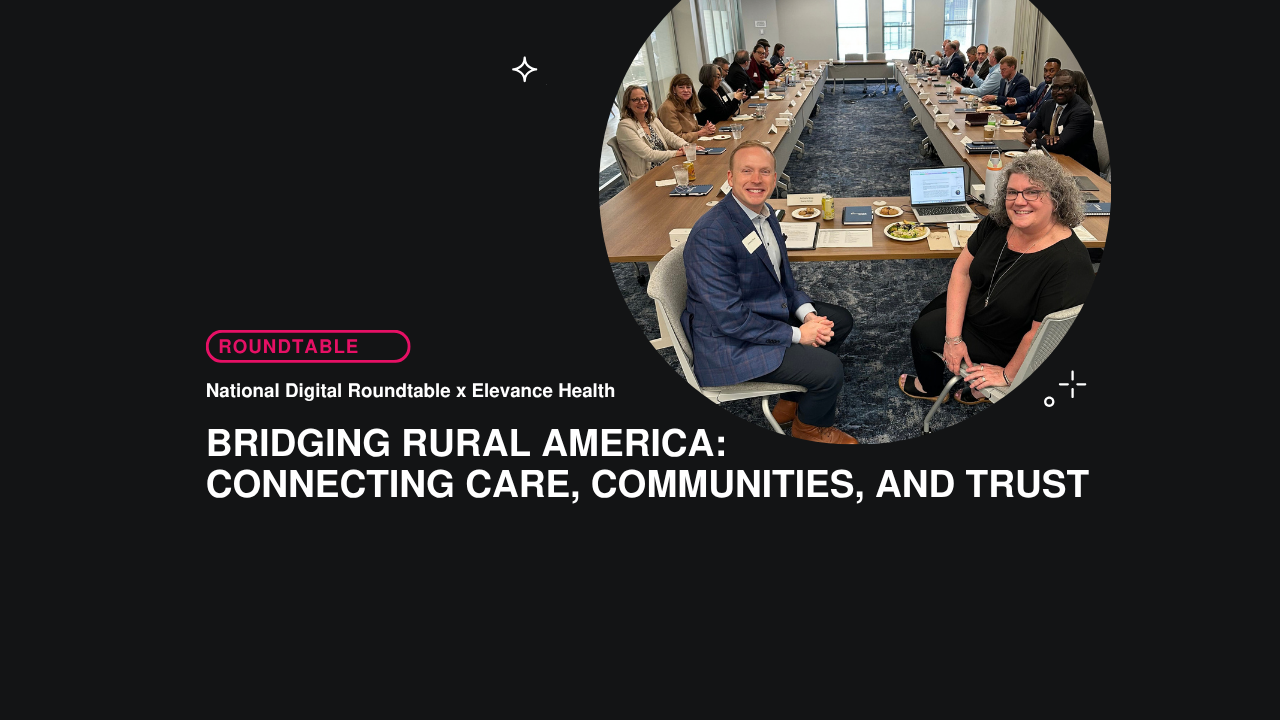
That observation captured the spirit of a National Digital Roundtable hosted with Elevance Health in Washington, D.C. Leaders working across healthcare, broadband, local and national community organizations, communications, and public policy explored a shared challenge: how to turn technology, resources, and relationships into meaningful access for people living and working in rural communities.
The discussion took place against the backdrop of the Rural Health Transformation Program, a $50 billion federal initiative spanning fiscal years 2026–2030. But the conversation extended beyond any single funding source to consider what health plans, foundations, providers, broadband organizations, and national and community partners can accomplish together.
This brief summarizes discussion themes without attributing comments to individual participants or their organizations. It does not represent a consensus statement or endorsement by participating organizations.
Collaboration is essential to delivering care
“Healthcare is a team sport.”
Participants repeatedly returned to the limits of working alone. Rural access challenges cross organizational boundaries: a healthcare provider may offer a service, a broadband organization may enable the connection, and a trusted community partner may help someone feel comfortable using it.
The discussion emphasized building on relationships and resources already in place, while connecting organizations that do not traditionally work together. Collaboration was framed not simply as a way to share information, but as a way to make services possible and sustainable.
The opportunity is to connect people and organizations that have not previously been connected, particularly where their capabilities complement one another. Participants also discussed a “no wrong door” approach to access, alongside trusted information, and health and digital literacy.
Connectivity is a spectrum, not a yes-or-no question
Connectivity emerged as a spectrum rather than a simple question of whether someone can get online. Participants raised affordability and connection speed alongside availability and reliability, highlighting the difference between having an internet connection and having high-quality internet that supports telehealth and other digital health tools..
Clinics need reliable connectivity, too. When patients cannot connect from home, they may still need to travel to a clinic or other familiar place, such as a library or school, to participate in a virtual appointment with a provider elsewhere. Telehealth can significantly expand access to care, helping eliminate many of the barriers that can make receiving care difficult.
Participants also raised the difficulty of sustaining services in less-populated rural communities. Investments that work in a larger rural hub may be harder to maintain in a smaller neighboring community. The challenge is not only reaching more people, but also reaching those with more complex health needs through conventional delivery models.
Digital tools need human support and familiar places
Digital health navigators and community-based telehealth spaces emerged as practical approaches to helping build trust in technology and making it more usable.
Connecting someone to care may require help with more than an internet connection. Resources and community-based models can help healthcare organizations develop navigator programs and create supported spaces for accessing telehealth. Examples include:
- Navigator program development: Benton Institute’s Digital Access Coordinator Program Playbook offers guidance on identifying digital-access gaps, establishing workflows, supporting patient portal use, and evaluating results.
- Community telehealth access: The Foundation for Rural Service’s Virtual Living Rooms program brings together rural broadband, Department of Veterans Affairs resources, and local partners to create private spaces where veterans can access telehealth.
Libraries, fire stations, clinics, and other community hubs featured in the conversation as potential access points that are familiar and accessible. The larger lesson was to pair digital capability with people and places community members already know.
Sometimes the next step is getting back to basics
One of the most practical examples promoted encouraging people to read their mail about all things related to healthcare, healthcare news and updates, Medicaid eligibility, and healthcare-related renewals.
That example reflected a broader discussion about connecting with people through the channels they actually use and trust. Community radio, local newspapers, mailed notices, and personal outreach remain part of the conversation alongside digital tools.
Participants highlighted the role of small, hyperlocal radio stations, including stations outside the NPR network, as trusted sources of community information and important channels during disaster response. They also discussed the importance of understanding who holds trust locally, including farmers, ranchers, and other community figures - roles that differ from those in urban settings.
Public research offers relevant context: Pew Research Center’s September 2025 national survey found that 70% of U.S. adults had at least some trust in information from local news organizations, compared with 56% for national news organizations. Those findings describe U.S. adults overall, not rural residents specifically.
The discussion identified an opportunity for healthcare and community organizations to coordinate outreach around Medicaid and other healthcare changes: reinforce official information through multiple channels and help people understand where to turn for assistance. Text messaging, ambassador programs, peer-to-peer, and train-the-trainer approaches were among the methods raised.
Rural access includes physical health, mental health, and social connection
The conversation encompassed children’s health, children’s mental health, substance use disorders, aging, routine access to care, and social connection. Prenatal care and childcare were also raised in a discussion of farmers and ranchers and the central role of agriculture and the food economy in rural community life. Participants brought perspectives concerning older adults, people with disabilities, young people, veterans, and agricultural communities.
Health-related social needs such as transportation, housing, and access to nutritious food, were part of this broader understanding of access. Examples included bringing medical, dental, mental health, and substance use healthcare together in one location and incorporating annual social-health screening into care. Social connectedness alongside access to clinical services was discussed as essential to whole health.
These perspectives reinforced the importance of listening to people living and working in rural communities rather than treating rural America as a single, uniform audience. Different populations and places may need different combinations of services, communication channels, technology, and personal support.
Moving from conversation to collaboration
The roundtable returned to a practical question: what becomes possible when organizations combine their strengths and resources?
Health plans, community organizations, digital health navigators, community access points, local-media partnerships, and coordinated outreach offered examples of where collaboration could take shape. Across those approaches, the focus remained on connecting people with care, useful information, and one another.
Resources for Further Exploration
Digital Access Coordinator Program Playbook — Benton Institute for Broadband & Society
A practical resource for healthcare organizations developing digital navigator programs and addressing patients’ digital-access and skills gaps.
Virtual Living Room — Foundation for Rural Service
Information about community-based spaces that connect rural veterans with VA telehealth, including guidance on partnerships, locations, and program support.
Trust in Local and National News — Pew Research Center
National research on trust in news sources. For additional historical context, see the 2019 Knight/Gallup study on public trust in local news.
Medicaid Community Engagement Requirements — CMS
Federal implementation context for organizations planning outreach. For individual eligibility, renewal, and enrollment questions, consult the relevant state Medicaid agency.
Rural Health Transformation Program — Medicaid.gov
An overview of the program’s funding structure and permitted uses, including technology-enabled approaches to rural care.
Organizations Represented
Participation does not imply endorsement of every view summarized in this brief.
Benton Institute for Broadband & Society; CHC: Creating Healthier Communities; Connect Humanity; EdWeek Market Brief; Elevance Health; Fauquier Free Clinic; Fisher House Foundation; Meals on Wheels America; National Academy for State Health Policy; National Association of Medicaid Directors; National Association of State Directors of Developmental Disabilities Services; National Farmers Union; National Federation of Community Broadcasters; National Health Council; Nelson Network Advisors; NTCA – The Rural Broadband Association; Sirona Strategies; Social Driver; The Trevor Project; USAging.