

Breaking Through the Noise: Thought Leadership in the Social Media Age
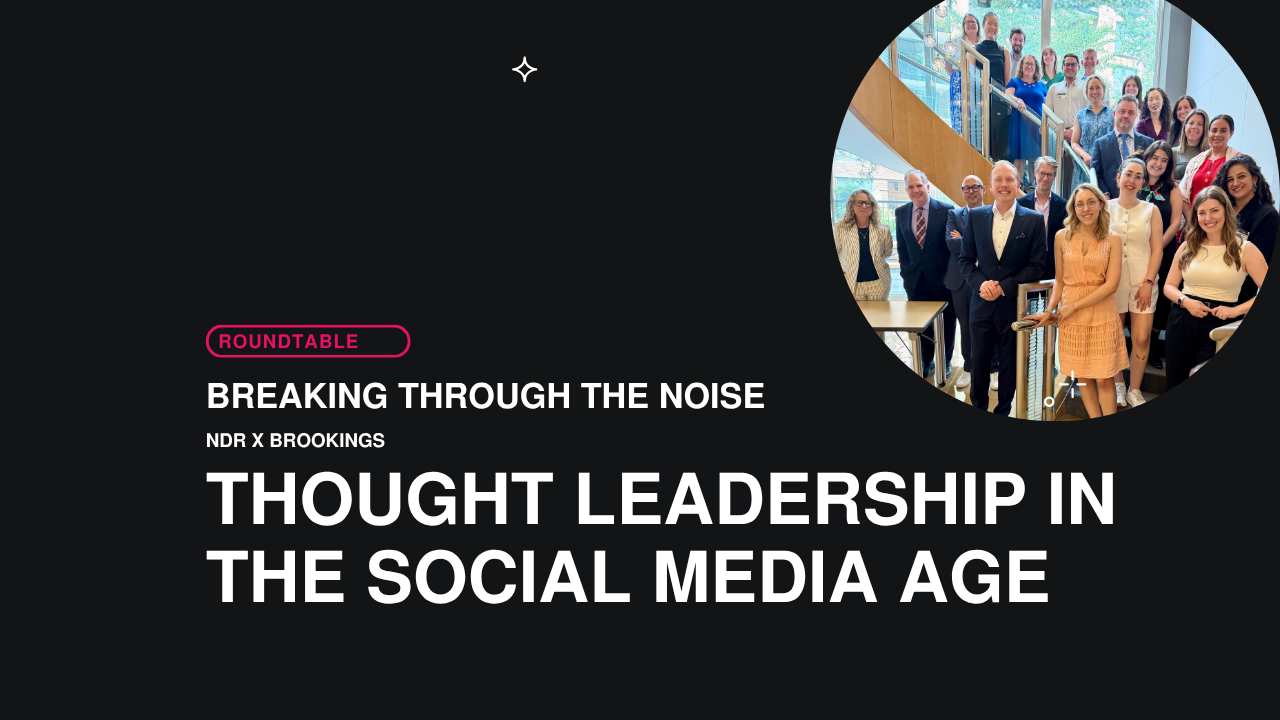
A National Digital Roundtable discussion at Brookings explored how leaders can communicate with clarity across platforms and generations.

The platforms changed. The need for clarity did not.
Social media has given experts and organizations more ways to reach people than ever before. It has also made attention harder to earn. Audiences move quickly between platforms, encounter a constant stream of competing messages and expect information to feel relevant to the communities they belong to.
That challenge framed a National Digital Roundtable conversation hosted by the Brookings Institution. Leaders from policy, advocacy, diplomacy, the U.S. military and coalition-based organizations compared approaches across LinkedIn, X, TikTok and Reddit. Their experiences pointed to one central idea: thought leadership is not simply a matter of publishing more. It is the discipline of translating expertise into communication people can understand, trust and use.
Start with the audience, not the platform
Every platform has its own culture, pace and expectations. LinkedIn rewards professional context and practical insight. TikTok favors accessible, human storytelling. Reddit communities expect specificity and credibility. X is built around speed and public conversation.
The strongest strategy is not to copy and paste the same message everywhere. It is to understand what an audience needs from a leader in each setting, then shape the message accordingly. The underlying point can remain consistent while the format, examples and tone change.
This audience-first approach also helps organizations avoid chasing every new channel. A platform is useful only when it connects a credible voice with the people that voice needs to reach.
Treat digital natives as strategic partners
One of the clearest themes from the discussion was the importance of communicating across generations and drawing on the expertise of digital natives.
People who have grown up creating, sharing and evaluating online content often understand platform behavior intuitively. They can recognize when language feels overly institutional, when a format will lose attention or when a community expects a different kind of participation. That perspective should enter the process early—not after a message has already been finalized.
Pairing subject-matter expertise with platform fluency produces stronger communication. Senior leaders bring experience, judgment and authority. Digital-native colleagues bring cultural context, creative instincts and an understanding of how audiences actually navigate information. Neither perspective is enough on its own.
Build community before asking for attention
Thought leadership works best when it creates an exchange rather than a broadcast. That means listening, responding and making space for other people’s expertise.
The roundtable itself reflected that principle. Participants came from different fields, but they recognized a shared communications challenge and learned from one another’s experience. The discussion created value because it brought people together around a useful question—not because one voice claimed to have every answer.
Online, leaders can take the same approach. They can ask thoughtful questions, acknowledge uncertainty, invite relevant perspectives and follow up on what they hear. Over time, those habits build trust and make future messages more meaningful.
Clarity is a form of leadership
In noisy environments, complexity can become an excuse for communication that is difficult to understand. Effective thought leaders do the opposite. They make complicated ideas accessible without stripping away their meaning.
That requires choices: deciding what the audience most needs to know, explaining why it matters and giving people a clear next step. It also requires consistency. A single strong post may earn attention, but a sustained pattern of useful communication builds credibility.
The goal is not to be everywhere or to react to every conversation. It is to show up with purpose, communicate in a way that fits the moment and help people make sense of an issue.
A practical way forward
Organizations looking to strengthen thought leadership can begin with a few focused questions:
• Who are we trying to reach, and where do they already gather?
• What expertise can we contribute that is genuinely useful?
• Which digital-native colleagues or partners should help shape the message?
• How will we listen and respond after publishing?
• What would clarity look like for this audience?
Breaking through the noise is not about being louder. It is about being more relevant, more human and more consistent. When leaders combine substantive expertise with platform awareness and a genuine commitment to community, social media becomes more than a distribution channel. It becomes a place to create understanding.